The Music Press Release Hype Machine Feels Broken

It's Sunday night at 6PM. I have spent the last three hours catching up on all the emails in my inbox. I want to write about K-pop, relax with K-pop or some other form of entertainment, but I am cleaning out my inbox and trying to find some meaning in the 1,000+ press releases that have appeared over the past few days since I last sat down and went through everything.
I have a full-time job, was traveling, and simply cannot fathom engaging with my inbox when it will be me sitting there just praying for some inspiration other than marking things unread and/or responding to press people that I can offer them only an opportunity in my newsletter, but unfortunately most outlets don't have budgets on May 31 for coverage of an early June release.
This is an atypical newsletter for Notes on K-pop, as it's not about the K-pop industry but about music journalism and the public relations industry it interacts with. I began writing this Sunday, and it's now Tuesday that I'm back to writing it. I've deleted hundreds of press releases since then, and read maybe 10-15 relevant to my coverage (music and business, especially in relation to K-pop). I responded to a few, inquiring about opportunities. All wanted the same major outlets, and only one offered a true story I could even create a pitch around. I spent so much time trying to play catchup in my inbox that I didn't have time to write some of the pitches I'd like to write. But I also don't want to miss any important emails, or potential opportunities for interesting topics or releases of interest, and so I wade through them all. By the time it automatically sends itself out at the scheduled publish time, I'll probably have another 50-100 press releases to skim headlines of and delete.
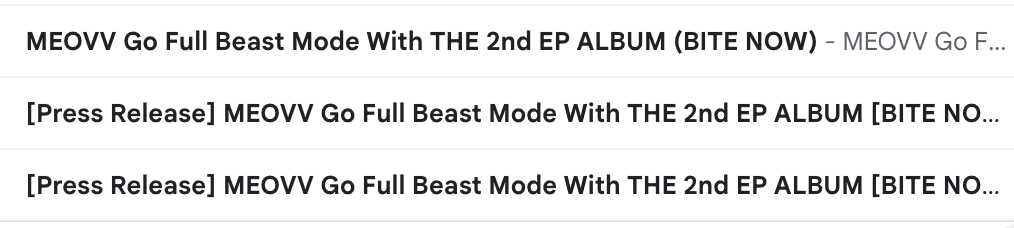
The deluge is two parts: due to a clerical error on my Muckrack page based on a very outdated Twitter bio of mine, or people not doing their research, I got added to some media lists as a Variety reporter. I haven't written for them since 2023, so although I'd like to get back on the roster, that won't happen with cold call press releases about everything from health to mechanics. The other part of the issue is simply the feeling that public relations teams are sending more press releases than ever, even if there are no outlets to provide coverage. There have been many times in recent days where I've seen not just one or two near-identical press releases back-to-back from labels and public relations (PR) agencies announcing something, but even three.
![KATSEYE: The WILDWORLD arena tour sells out in less than 48 hours including newly added dates in New York, Los Angeles, Lon[don] twice in my inbox](https://storage.ghost.io/c/ed/2b/ed2bd952-a157-4e6f-9cea-ab2e914e89f7/content/images/2026/06/Screenshot-2026-05-31-at-4.00.24---PM.png)
For K-pop, this is exacerbated as I often get press releases from Korean teams, American teams, and their PR counterparts. If there's a concert, the ticketing agents and venues also send out announcements. This happens for all artists, and I confirmed with an entertainment editor friend at a major magazine that duplicate press releases are indeed always happening regardless of genre or industry, but that it definitely feels like things are getting worse.
It would be only a minor annoyance at worst if not for my entire inbox being flooded with repeated information with nowhere to go. But it's often information that is either irrelevant or not useful beyond a quick news piece, which I haven't written since I left my job at the South China Morning Post. Sometimes I think of sharing all press releases headlines on social media as a way to handle the quick news and stay in the game, but even that's a job in itself nowadays. And nobody really cares anyway. News moves too fast. Nobody reads. I think frequently of the famous phrase of Ecclesiastes (קהלת), "Hevel hevelim" in Hebrew, often translated as "Utter futility".
Journalism as an industry is constantly pretty much a failed entity, but in 2026 it feels worse than ever. As Eleanor Halls wrote in her piece on The Devil Wears Prada 2, "journalists know we won't get Runways happy ending." Budgets are tight, and so everyone has their own newsletter they're hoping to make do with. But public relations, agencies and artists only want the biggest outlets or the most popular content creation channels. They shoot out press releases, it seems, just to see where it lands and if anyone will cover.
It feels like the onus to get every story out is on the writer nowadays, rather than the public relations reps. In the past, press releases were to inform and enlighten, but especially to start a conversation. Writers and others in the media industry might refer to them, be intrigued by them, and cover them, but especially use them as starting points; a press release often was followed by a follow-up email. When I ended up on PR lists as a fledgling writer, it meant an opportunity to connect. But now they're often the be all and end all. They're a paint-by-numbers force to overwhelm. Only a handful tell me something new, or tell me in a timely manner to plan coverage. I don't know which of the multiple press releases I should respond to if I do have a question. It feels like anytime I ask a follow-up, it goes nowhere if I can't immediately deliver coverage at the exact outlet they want.
I'm sure people who are working full-time in this industry are more typically in conversation with PR people, but as a freelancer it often feels like a one-sided wall where I'm being thrown against information I didn't ask for, and asks for promo that feel pointless. You do not need a journalist to get a newsworthy moment out there in 2026, that's what influencers, fandoms, and social media is for. But you do need a journalist to take stories deeper in 2026, and the industry feels like it's not really ready to admit that the press release machine as we know it may actually be dead.
If I weren't a freelancer, perhaps this would be helpful to help me plan my content calendar, but as a freelancer it becomes another heavy cognitive lift I have to wade through in order to determine whether I actually have any emails in my inbox that are valuable. I am constantly playing catchup, responding to people week's late with apologies and missed opportunities.
But this shouldn't be the job. And I'm not the only writer who has noticed that something feels very off lately with the way entertainment PR works.
Earlier this week, I posted a question on Instagram asking PR and journalists to share their thoughts on press releases. Only journalists responded, which wasn't unexpected (I would really love to hear from PR folks if you want to chat anonymously!), but the answers were surprising because I thought I was the only one who has been overwhelmed by the nothingness lately.
All the responses felt very similar: too much information with too little timely, actionable content, and copy-paste content that in the age of AI slop feels even more of an overload of nothing.
"They tell me nothing new," wrote one culture writer.
"They're too long! Just send a brief email! Bullet points! If I'm interested I'll reach out anyway," wrote another.
"👎 Occasionally I read a really well-written one but most read like AI generated crap," wrote one writer I previously worked with, who has now also left journalism as a full-time role but still moonlights.
"It depends but I don't need to know someone played Coachella after the fact..." wrote one radio journalist.
"There are sooooo many of them and some are definitely AI but regardless all are terrible," wrote the editor of a literary magazine.
"Very new sense of entitlement I'm seeing where streams are posed as legitimate stats," said one culture writer, highlighting a deeper issue about the music industry, but I'm including here because that "sense of entitlement" feels like the big issue here: Writers do not owe public relations people anything if the relation does not exist. Journalists typically spend time working alongside, oftentimes befriending, our peers in the PR world. Relationships are forged over time, not one-sided memos.
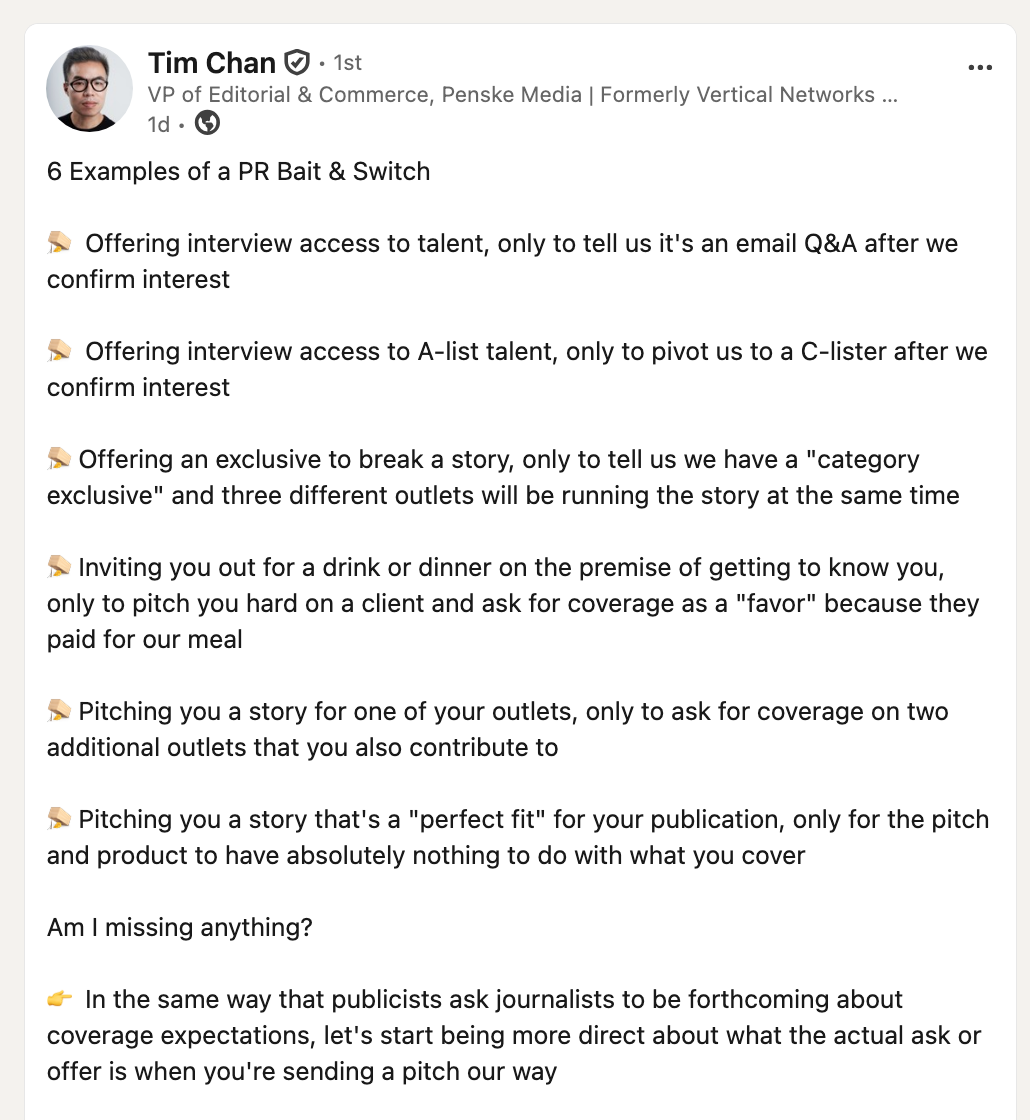
If you think this is just an issue with press releases, think again: just yesterday, Tim Chan, the VP of editorial & commerce of Penske Media posted "6 Examples of a PR Bait & Switch". In it, he listed six instances of ways he perceived PR slights.
"In the same way that publicists ask journalists to be forthcoming about coverage expectations, let's start being more direct about what the actual ask or offer is when you're sending a pitch our way," he ended with.
Penske operates many of the biggest names in entertainment: Billboard, Rolling Stone, Variety, The Hollywood Reporter, Vox, Vibe, and Deadline are some of their most prominent media brands, but they also run award shows and chart data companies. If a vice president there is frustrated with how public relations works in 2026, and writers are frustrated with how public relations works in 2026, maybe public relations simply doesn't work very well in 2026.
But it doesn't stop there: I saw this after I already had decided to write this piece, but over the weekend Alex Young, the founder of Consequence, posted on Linkedin about the very same issue of press release influx. "Curious question for fellow music journalists: There’s more new music out there than ever. Streaming services have said as much. How do you keep up with all the new releases sent to you on a daily basis?"
![Curious question for fellow music journalists: There’s more new music out there than ever. Streaming services have said as much. How do you keep up with all the new releases sent to you on a daily basis? On a typical day, I probably get around 500 emails about new music releases. I feel an inherent responsibility to check out as much as possible, but it often becomes overwhelming. I know some people rely on trusted publicists or labels, but that seems like a disservice to artists who don’t have those resources, or who aren’t lucky enough to be signed. Long story short: I’d love to hear how others sort through it all. [Inbox shows 1-49 of 85,113]](https://storage.ghost.io/c/ed/2b/ed2bd952-a157-4e6f-9cea-ab2e914e89f7/content/images/2026/06/Screenshot-2026-06-02-at-11.13.29---PM.png)
The post was shared on a journalistic Instagram page, and the responses essentially were an amalgam of music writers going, "Well, I just don't read them because I have to spend my time listening to music and not going through my inbox." To be honest, I very rarely discover new artists from press releases, and by the time I get one about an artist I'd like to cover, it's usually not anything I have bandwidth for because it's arriving immediately before or just post-release. Or, if it is timely, the story simply doesn't exist; editors don't care about a new album release or tour from anyone but the most impactful, intriguing names in the industry when their budgets are being cut. If there's no story, why are you trying to get me to create one from thin air?
I am curious if every PR rep feels as frustrated by everything from the other perspective, like they're just screaming into the void. If they too feel like the failure of the journalism industry has failed them. Every conversation I have with PR peers makes me think that we are all worn out, and this is a slog towards demise, but we have to keep working at it in the hopes of that ultimate joy of seeing a great story come out of these connections.
I actually was going to write a piece today on something else (the return of Second Gen K-pop relevance will be for next week), but it feels like the journalism paradigm is constantly breaking apart and we're renewing ourselves. I hope that public relations can as well, because it'd be nice for this to become more of a collaboration and storytelling, and less a slow roll towards press release inbox spam cycles.
This is all to say: Sorry in advance if I'm late in getting back to you. I am drowning in words that tell me very little, and inspire even less. Let's go get coffee or set up a call.
What I'm working on
I asked on Instagram what people wanted to read about this week, and the poll winner was about the Second Gen comeback of the moment. I will cover that next week! I promise I'm already writing it.
I've also submitted a piece to the newly-launched Fansplaining publication, a new iteration of the podcast. The process of speaking to 20+ people and writing really inspired me, and I'm feeling really motivated to write more in the second half of 2026. Please let me know if there's anything you'd like to hear more about.
What I'm listening to
SHINee's Atmos EP is a true-to-form album from the group, reminiscent of their View era. I honestly can't say what my favorite track is, as they're all really engaging listens.
TripleS's <LOVE&POP> pt.1 is a similarly excellent album, put out by the always stalwart girl group. They were released at the same time, and it honestly felt like a truly blessed day.
aespa's "Camouflage" is their ultimate b-side from the group's overall excellent Lemonade album. This release really feels like the first true major SM Entertainment LP in a while after last year's dearth, and the fluttering, kinetic push-pull of aural hyperpop.
MEOVV's "In My Hands" starts off has this slightly rockish and sleek energy hidden beneath its hectic exuberance that just hits exactly right. I could honestly do without the raps, which I think break things up a bit too much, but I hope they promote this song as a secondary single because it deserves its laurels.
What I'm reading
Back to Fansplaining, I very much enjoyed Elizabeth Minkel's "Too Big To Fail (On Television)" looking into why the tech industry features such underdog mentality even when it can't ever accept failure. I also felt like "There are currently only three fanfics on the Archive of Our Own written in Swahili" is an important read for many of us out there.
Carmen Chin's review of NMIXX's Heavy Serenade is a great read.
"Has New Music Become Less Popular?" from Stat Significant is thought-provoking, especially next to Sam Hockley-Smith's "Does Anyone Like Music?"
"How Toronto’s Sofia Kay manifested her way to Seoul to write for the biggest K-pop stars" by Samanth Lui of Bunni Pop is a great reminder that the people creating K-pop nowadays are often people who were raised on K-pop.
What I'm watching
Netflix's My Royal Nemesis is gearing up to be the best K-drama of 2026 if they don't fumble the ending. Please go watch if you haven't. I am sitting here eagerly for this weekend's episodes.