In Brooklyn, Key celebrated a nostalgic, assured two-decades of artistry

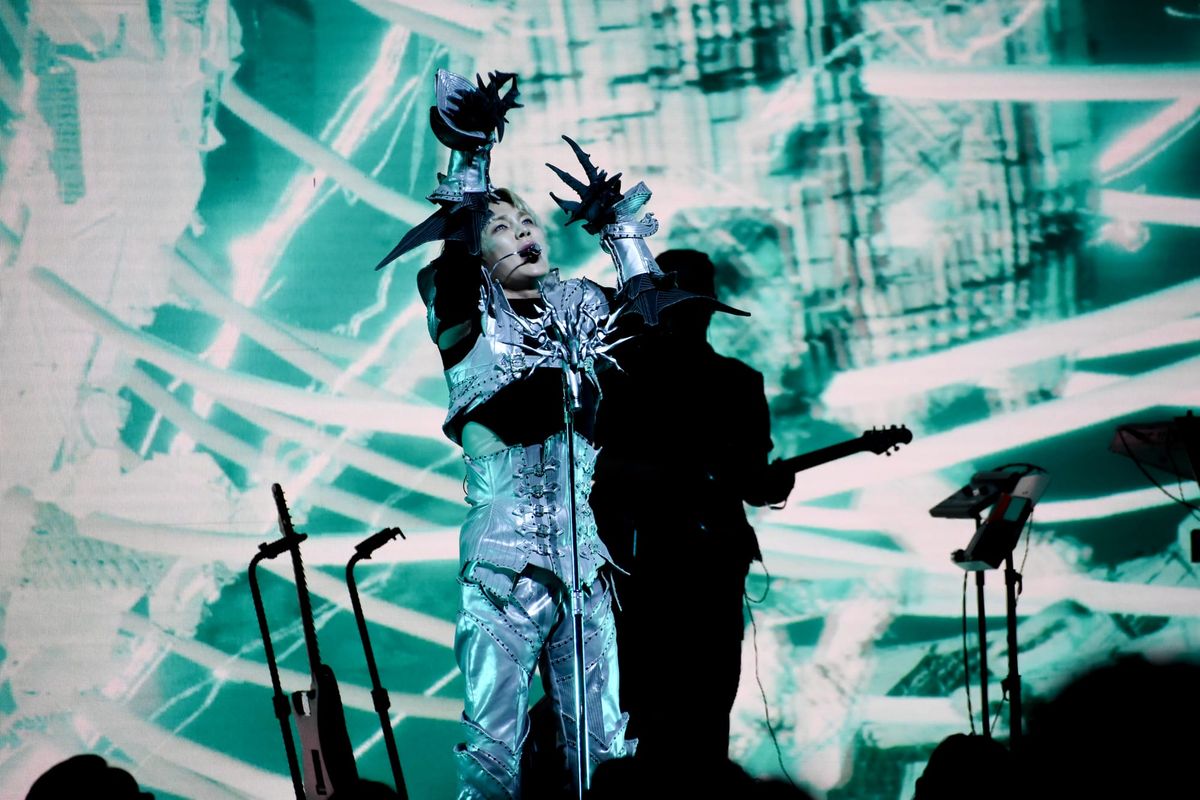
Key's show at Kings Theater on December 10 felt like a celebration of himself, even in the moments when he had to catch his breath. Because, as he says, he's "not 18 anymore."
But, as the night went on, it felt like the moments where he caught himself and acknowledged the length of his career were one of the main parts of Key's story as we entered Keyland.
Having been born just six days after Key in a very fateful September, I've always felt an affinity for the SHINee member, and was looking forward to see him unleash his Keyland: Uncanny Valley concert on New York City. At 34-years-old, it was the first time he performed solo on a US tour. But having been active as a member of SHINee since their debut when he was 16, it wasn't amateur hour but rather a retrospective of what it means to be a pop star for nearly two decades, with no intention of slowing down.
Uncanny Valley opened with gothic glamour and sci-fi drama as he ran through opening numbers like "Strange", "Helium" and, my personal favorite, the sleekly addicting "CoolAs".
"This man knows what it means to be a glam pop diva in silver," I wrote in my Notes app as Key first appeared on-stage. "The most obvious homage is Gaga, but he is his own muse and craftwork."
At a time when K-pop has increasingly done away with stage costumes, it felt like this was the K-pop concert for theater kids everywhere. Even the crowd was dressed the part, and throughout the night Key continuously commented on fans' outfits, complimenting them for being better dressed than he was. "I'm like at the Key version of Comic Con," he said at one point.
Talking back-and-forth with fans in the intimate environment of a theater on a rainy Brooklyn day, it felt like Key was leaning into the ability to be closer with fans after a career that had elevated him, and the rest of SHINee, as idols playing on larger stages. It felt like he was looking at this solo tour was a step back to reassess where he is, where's been, and where he's going, especially when he commented on some of the artists he knew who had performed previously at that venue. Diana Ross, Ed Sheeran, and, of course, Taemin, had once stood where he now was finally, after nearly two decades, getting a chance to shine solo in New York City. (The last one, of course, got rousing cheers and laughs.)
"She's 4-years-old and 'Replay' is 18-years-old," he ruminated on at one point, in reference to a child someone had brought with them. This brought to mind that not only was Key an older young adult, but so were the rest of us: I ran into a college friend at the show, who I hadn't seen in a while, but she just had a baby a few months prior. We, like Key, are growing up.
This train of thought that Key brought up reminded me of a long ago conversation he and I once had when I was writing for Billboard, about how "Replay" could never get rebranded from "Noona Neomu Yeppeo" to "Dongsaeng Neomu Yeppeo" – from older woman (literally, sister, a common Korean term for both families and interpersonal relationships) to younger woman.
"To Key, asking SHINee to no longer sing to their “Noona,” could potentially happen, someday in a blue moon. “Girls’ Generation, they have to change their name first,” he says with a laugh, referring to another popular act created by SM. 'No more ‘Girls’.'" - SHINee Looks Back on Debut Song ‘Replay’ Ten Years Later (Billboard, June 21, 2018)
Key has, quite literally, lived his life on stages, and is still finding ways to make those stages feel refreshed and exciting. I wonder, if at the heart of it, that's what is so uncanny about Keyland: the fact that it is not uncanny, except that he's still making it as such. In K-pop, longevity is only received by those who demand it, and who put in the work to survive in the youth-focused field. Key has done just that, and still hitting new moments and milestones – such as performing a solo show in New York City for the first time – nearly 20 years in feels like such an outlier of a feat.
During one particularly comical moment that has since gone viral, Key talked about how his relationship with Taemin has changed over time, revealing that SHINee's youngest member has never once texted him just to chat throughout their entire relationship... until recently.
"Taemin texted me with no reason. So I was... [makes shocked expression]. Do you need something? Do you need me to do something for you? Do you need me to order some food? 'Are you enjoying U.S.?' Am I enjoying U.S.? Do you need something from the U.S.???
Including trainee, it's been like... I've been seeing him 20 years, it never happened. So if you have a boyfriend in your 20s, wait a little. Are you evolving or something? People change."
As comical as the moment was, it felt very appropriate: this was a night when an older young adult – I refuse to deem our 30s middle-aged when nowadays it's not uncommon to live until your 90s – was doing something new but that felt very comfortable. It was change, growth after 20 years, a positive evolution .
Key was assured in his ability to pull off the high-drama of his performances, and confident in his abilities as a singer and dancer to the degree that he not only knew exactly when to hit his marks but leaned into simply not singing rather than pretending to lipsync during moments when dancing made singing impossible, but he turned that itself into part of the art.
But it was also a bit new, and tentative, both his music nostalgic as a conceptual idea and his candor – almost longing – for the years he wasn't able to tour, either in the U.S. or as a soloist. Coming into his own, there was no shyness, just someone who had worked hard for so long and could now chase after what felt right in this particular moment.
Towards the end of the night, Key talked a bit more about his performance and songs, and how he never expected "Glam" to be such a popular song.*
"I never thought this genre would come back again," he reflected. "The first time I heard 'Glam', I thought, 'isn't this too -'" At that moment he paused as people in the crowd started shouting to stop him, as if begging him not to demean the glory of the song. "No, no, let me say something!" he insisted. "'Isn't it too 2005?'" he continued the recollection. "All the composers were 20 or something, 20-odd years-old. So they were like, 'Yeah, it's like retro.' Retro, huh?"
Considering that the music he and I grew up with, quite literally music from the 00's and 10s', are part of the recent nostalgia drive ("Will nostalgia be the defining aesthetic of the 2020s?" Dazed recently asked), it makes a lot of sense: by having started his career young (too young, if you ask me, but so it goes in K-pop), Key isn't only getting to create but recreate himself time and again. I often think about why he leans so hard into the nostalgia of the '70s, '80s, and '90s for his solo work's musical and visual aesthetics, and it hits me time and time again that be leaning into his own nostalgia of music from his childhood, he's getting to reinterpret those sounds for a moment that he's witnessed to and partake of in uniquely creative ways. Not everyone gets to live long enough to recreate their own influences, but Key has made himself an icon for that.
Personally, I hope his next album is titled Retro, Huh?
*I love "Glam", but was surprised that my personal standout performance from the night was "Gasoline", a song I never really liked. But he brought it to life with a rock, headbanger of an update that really made me rethink my prior disregard. As I wrote in my notes, "I've never really liked this song but now I see the goddamn vision."
What I've been working on
I wrote about NMIXX's "High Horse" and BLACKPINK's "Jump" being two of the best K-pop songs of the year for NME.
 NME
NME
What I've been reading
While I was writing this review, Key became increasingly immersed in backlash over non-regulated medical treatments from an "injection auntie", and has since stepped down from his regular role on several South Korean television shows. I am not really confident in my understanding of the situation to really say anything about it in the context of the review, but I can't help but wonder about how aging in the spotlight plays into all of this.
 Lee Jung-joo
Do Music Stars Write Their Own Songs? A Statistical Analysis by Daniel Parries for Stat Significant - "In this week’s visit to Bummer Town, we compare songwriting credits for female and male artists—and find that male artists receive higher rates of songwriting recognition, sole authorship, and producing credits across the board."
"Top 10 Highest Grossing K-Pop Tours of the Year" by Eric Frankenburg for Billboard - "Simply put, K-pop has never been stronger on tour than it is right now. The genre represents 7.7% of the year’s top-100 tour grosses, surpassing 5.1% in 2023 and 4% in 2019." This feels very different from the experience of my reporting on the ground at concerts, but I foresee 2026 will have many more tours based on this numeric success. I hope people take into account the reality for many fans.
Relatedly, 2025 is ending in a really grim way for entertainment journalism at some of the few outlets that remain seemingly viable: Billboard, Variety, and Rolling Stone, all under the Pensek umbrella, have recently been gutted of some of their most insightful and authoritative voices. Per The Wrap, "Billboard cuts include editors at large Robert Levine and Steve Knopper, senior director of live music and touring Dave Brooks and lead analyst Glenn Peoples". Friends and I have been theorizing that this will lead to condensing of mastheads, cross-sharing of content, and less opportunity for deep reporting. I hope we're proven wrong.
This comes at a time when celebrities are moving to Substack and starting to emulate written blogosphere-style reporting/journaling/whatever you think of Notes on K-pop. Sowmya Krishnamurthy of Deluxe Edition ruminates on what's going on, in "Why Are Celebrities Taking Over Substack?" and why this is bad for journalism.
And going along with that... "Why the Music Critics Keep Writing" by Tobias Hess for Study Hall. "From my vantage point (I am a culture writer and music reporter), it is an undeniably strange moment for music criticism. In July, The New York Times reassigned multiple music critics to new roles, vocal fans have given critics reason to be cautious, and the creator class and even a forthcoming ratings innovation from Pitchfork are blurring the distinction between fan and critic... A more rational economic actor would have pivoted to crafting ad copy a while ago. But still, music criticism is being pitched, commissioned, and written by a small yet ambitious group of writers. Maybe the question shouldn’t be: Is music criticism dead or dying? Maybe it’s: Why on God’s earth is anyone still at it?"
And on the business side of things... "Returns of BTS, BigBang, EXO put K-pop stocks back in play" according to KED Global's Eun-Hyeok Ryu.
What I've been watching
I've become obsessed with Taskmaster. I haven't done anything productive lately, as I have finished my day's work and sat down to watch a series a night. I don't know what has happened to me. Please respect me in these times, and also please comment on your favorite K-dramas of 2025 if you don't mind, because I am very behind and really concerned that I missed something excellent. Please send recs!
Happy holidays, happy new year, and may 2026 be kind to us all.