In Conversation: "The Rose: Come Back to Me" director Eugene Yi and Producer Diane Quon

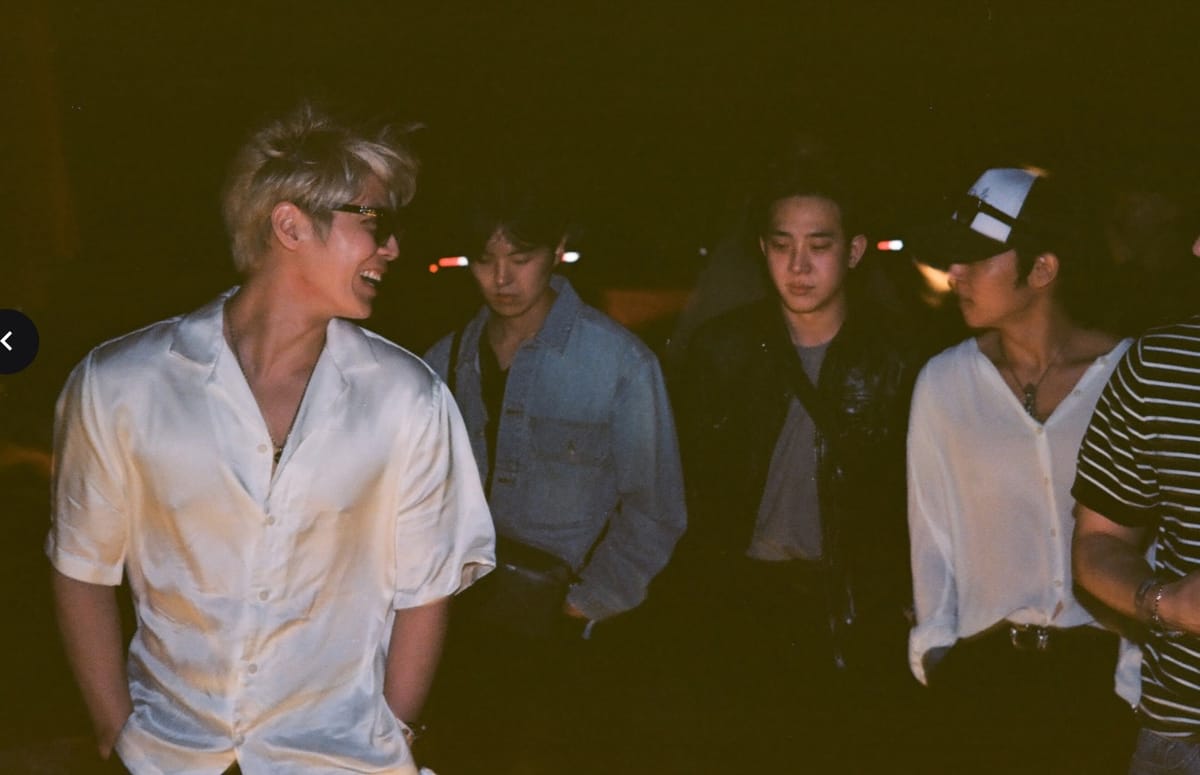
If you've followed The Rose's career, there's no question that they're an act deserving a documentary. The Rose: Come Back to Me, in theaters now, was released over Valentine's Day weekend, and centers on the band's trials and wins over the past decade.
I've been writing about the group, ever since their debut song "Sorry" won its way into my heart and those of many others', and blurbed it for Billboard's best of 2017 K-pop list. I've spoken with them a few times, and last spoke with them in 2023 amid their return after contract disputes and military enlistment, and it felt like a time of the ultimate comeback. They went onto play Coachella in 2024. I thought I knew a lot about The Rose, but Come Back to Me, with a title referencing their 2023 single "Back to Me", shines the spotlight on difference facets of the act's career and their individual, and group, struggles.
And the architecture around all that is really their fellowship, and their brotherhood and their faith in each other and the music that they make together.
The band's members – Woosung (Sammy), Dojoon (Leo), Jaehyeong (Jeff), and Hajoon (Dylan) – all went through the K-pop training regiment, but, after a contract dispute with their former company, are now independent artists. The film isn't a concert film, or even a history of the group, but a different sort of documentary that is atypical to see from K-pop adjacent acts.
Ahead of the release, I spoke with director Eugene Yi and Diane Quon. Our conversation touched on the importance of healing via music and friendship, their creative process, and one of my favorite descriptions ever of K-pop, courtesy of Yi: "a live organism that grows and develops as any system will."
Please enjoy what Yi and Quon had to say, and watch The Rose: Come Back to Me if you have the opportunity to do so.
Tamar Herman: How are you guys doing? It's being released tomorrow, right?
Diane Quon: Tonight, actually. In Korea, it's tomorrow, February 14th. And in terms of marketing, it's easier to say February 14th versus Friday the 13th. But technically, in the U.S, you know, because usually a run starts on a Friday night, it's actually opening tonight.
Eugene, you're going to a screening tonight.
Eugene Yi: I am, yes. I was gonna try and drop by a couple just to see how things were on the ground, so we'll see.
A couple?
Yi: Well, I'm very close to one of the theaters where it’s screening, so I'm just curious, like, how it'll go, like…There's the fandom, and people show up, but you know… It's still a documentary in the theaters, and so [I’m] just curious what it's like out there.
Quon: It's great that Eugene’s been there. He's become like a celebrity to a lot of the [Rose fandom] Black Roses now, too, who've seen Eugene at so many of the festivals.
Eugene Yi: The fandom has really showed up for a lot of festival screenings. I've gotten to know a lot of them because they come to multiple screenings. Some of them have seen the film seven or eight times. There's a couple of fans who literally watched the film and then turned around and went back into the theater to watch it again, literally the next screening. It's a documentary. I was just inspired by their passion more than anything else.
And I think what's been nice is that, you know, The Rose is not BTS, right? It doesn't have this, like, gigantic, overwhelming fandom, so the community is very tight-knit. To see that community kind of come together and support the film has really been wonderful and nice. I think Diane felt this, too, but it's really been a warm embrace from this fandom. I hope this doesn't sound too corny, but it's really just kind of been like that.
We just did a Reddit AMA yesterday, and I'm sure you can imagine Reddit AMAs can go sideways very easily. But I don't think I saw a single troll or weird off question. Even the ones where there were frustrations or something, [they] were all coming from the perspective of open and honest conversation. I think that really reflects the fandom, and I think that really reflects the experience that I've had, I know Diane's had, and I think other team members have had, too.
Quon: Personally, I'm not part of a fandom, so I really wasn't aware of a lot of the things that fandoms do to support each other. So not just the band, but each other, which I love. The community. I remember going in line just to be out there for one of the concerts, and people were giving me gifts. I was going, “this is so nice that you don't even know me”. These are hand-made. And everyone talks to each other. So I've been really impressed with the community, and then how they have embraced us. By doing the documentary now, we're part of a family. And I think it speaks a lot to the generosity of wanting to be part of the community and interacting with the fans. I think it's as rewarding to us as it is to them, getting to know the fans who want to talk with us.
That is so lovely, honestly, and it makes me curious about how you both became part of this community now. I've followed their career since they debuted, and I've seen it all, but it was interesting to see the doc put it in perspective, so I'm really curious about how you both became involved in it?
Quon: I was approached by Janet Yang, who's one of our EPs [Executive Producers]. She is on a board with James Roh and DPD, who are part of Transparent Arts, who manage The Rose for many years. We're talking to Janet, and she was saying they were saying what’s new, that they just signed up this new band, The Rose, “you gotta listen to them, they're great. They were part of the K-pop system, but broke out of that and decided to pursue music in the way they wanted to, which is much more challenging, but felt more true to them, and also it was in the K-Rock genre versus K-pop.” And so with Janet, we were talking about different ideas, and she told me, “Oh, I just heard about this band, The Rose”, and a little bit of their background. I love that kind of underdog story, or of wanting to pursue your dreams in the way that you want to, versus how people tell you, even if it's easier. Although I would never say the K-pop system is easy, I mean not everyone makes it through, but it’s definitely more challenging when you decide to go on your own and do it in a different way.
And also, I always wondered, like, what happens to musicians who go through the whole training and then don't make it. Do they just give it up? What happens to them? So we approached TA and asked if The Rose would be interested in a doc. And they were.
Then I met with each of them separately in a Zoom, and… Once I met with them and saw how willing they were to be vulnerable… They shared some of their stories with me. It really made me think, okay, this could be a really… a real doc. Not a concert doc, or not just a small music doc but a real documentary that gives a real sense of who The Rose are, each member. So then I reached out to Eugene to direct.
We worked on a film together previously. He was one of the editors, and, luckily, he said yes.
Yi: We did that previous film, it was called AKA Mr. Chow. I was part of the editing team, as Diane mentioned, and I loved working with Diane. I admired her work, of course, from afar as well. So I was happy to chat with her. And the thing when she described the project that really just immediately came to mind was just that… I've just always been a little bit obsessed with Korean rock. I grew up in LA, and so there's plenty of K-pop all around. I'm just a music fan in general, but whenever I would hear a Korean rock song, it would just always raise all these questions of just, why… Well, first of all, this is awesome, but secondly, like, why isn't there more of this?
And it was the 90s, so a lot of me and my friends were doing that game of spotting the Asians in the different bands that were prominent. Oh, Smashing pumpkins, James Iha. Tony Kanal, No Doubt. But that, of course, raises the question of like… Why is it the random person in the background or instrumentalist? Why aren't there more faces like ours who are making this music? So that kind of fueled a lifelong fandom. So when Diane reached out, I was immediately interested, and then I learned more about The Rose, because I wasn't super familiar with them, beforehand, it felt like a story that needed to be told.
Everything they've been through… Any one of those speed bumps is enough to derail, I feel, any other band. I think we all can think of examples… Lawsuits, or the military, or any one of these factors can just sort of stop a band in its tracks. There's just so much story there, and then just hearing from Diane about meeting the guys, and then meeting the guys myself, it was just like, “Oh, this is incredible.”
They've not only gone through all this, but they're totally open to talk about everything, which isn't always the case, so… That was my goal from there.
Quon: When I was saying I had those initial calls with them, that's when they already spoke about some of the mental health crises that they had. And for me, I have children of my own. Well, they're young adults. And I just have seen how mental health has become such a big thing, both in the U.S, but all over the world, really, and Asia as well. And I loved that they were willing to talk about it, which is so, so unusual. For men, much less Asian men, to talk about mental health struggles. I thought this is a way to hopefully help others if they saw these four good-looking, successful guys share what they've gone through, and that's okay to talk about it. You're not alone in struggling with things, and so my hope was that through this story, we could also share that message.
As you say, mental health is a major topic within the film, and I have to admit bawling my eyes out about Jeff’s experience about having to comfort his father after going through an incredibly terrible mental health situation. That was all so touching. But when I finished watching and was preparing to talk with you, it hit me that it felt double impactful not just because of the emotions of it all, but because Jeff seemed to say that he started going to therapy in the military. That he started getting medication and regular sessions during his time in the military.
He didn’t say it was the first time, but it felt implied, and I thought that was such an… Odd? I don’t know if it’s odd, what’s the right word here… It felt like a conflict with the idea of masculinity and soldiers, and what I think of the military. He spoke about it earnestly, but with a sense of appreciation. He was in this hub of patriarchal regiment but they provided a space and help for him, and, at least in my mind as someone who never served in the army in any country, it felt like it would be the final place to get support amid all the build up that led him to a terrible state. I thought that dichotomy was just absolutely wild?
Quon: Yeah, so that's an interesting point, you're right. And he speaks so highly about the people who helped him, so that was good to hear, that they actually were wanting to listen and help him. He was even hospitalized, and they had that sort of support.
Yi: And he became inpatient, which, there's a degree of support that… Yeah, I don't know. I mean, not being an expert on the situation here in the States, it's difficult to compare, but at least, you know, in Korea, there is a conversation about mental health that happens, but from what I gather, it's like the conversation here to a certain extent. There's a lot of talk about wellness and well-being, but it's not necessarily getting to the root of matters in the way that Jeff was just so generous and open in talking about.
He was so open, and I was taking notes as I was watching, and I wrote one about how his situation was terrible and unfortunate, different sessions, how they increased, how we started medication, how it led to difficult choices and hospitalization… I have never heard anyone in any industry, but especially not the Korean entertainment spaces, really discussing it quite that way. And the way he was just, discussing it kind of as this terrible thing that had happened, but also something that had just, you know… It was another thing in life to overcome? I thought it was quite beautiful, the way he relayed it, and the way that you relayed his experience. Like…life happens and it sucks, but you can also work your way through. I just really was touched by that.
Quon: You can find a way to move forward, yeah.
I feel like that's their story.
Quon: Yeah, it's true.
Yi: Yeah, with the support of each other, with the support of the network that they have around them, their family, and everything.
I thought your emphasis on the family was really interesting. You spent time with Sammy and his mother, Jeff and his dad.
Quon: And we actually have a lot more with Leo and his parents. We did an individual trailer that Eugene cut, we did individual trailers of each of them, and it was to show scenes that we weren't able to put in the film. And so you'll see in Leo's. And you get to see a little bit of Dejun’s parents. They also were really gracious in letting us film.
Why did you end up ultimately cutting them?
Yi: Some of it is just kind of the usual thing that happens when you're editing, and you just sort of try and feel for when your movies might start to lag. And we had to balance four guys, four backstories, just trying to give everybody a little bit of something to be able to connect with them, but not letting the overall narrative bog down. Which is why I think we're so grateful that we were able to make these little individual trailers that are some of the deleted scenes from the film.
But I think you're right to point out the family, because it's sort of also nice to counter certain stereotypes there might be about Asian parents in particular, and, like, tiger parenting, or what have you. All these parents are so supportive. I mean, they're worried, for sure.
Quon: And I don’t want anyone to think that the scenes with parents were lagging or anything like that. It's more the idea that we only had 90 minutes, and so you're just trying to think of what you can keep in, what will keep the film going, and not be sidetracked too often, and so there were so many things we just couldn't put in even though we truly love them. We just had to see where the story could focus in those 90 minutes.
What do you feel like the narrative ultimately became?
Yi: We've talked about healing and just sort of how that underscored a lot of the initial interest in the project, [that’s] one of the themes we hope people take away.
And the architecture around all that is really their fellowship, and their brotherhood and their faith in each other and the music that they make together. I think as we were working, whenever we went away from that, it felt like, as much as we loved other parts, it didn't support that as much as we might want it to. Like you mentioned, I think it was the case for us as well, Jeff and sort of his whole arc, and especially those series of scenes around there, where he's talking about his mental health issues… Seeing the way that the footage even supports this idea of the guys being there for each other when they perform the song, and the guys all sort of, like, picking up part of the song, like, as it goes along. It is just something that resonated with us so deeply, and that just felt crucial.
So, for Hajoon, for example, in his trailer he talks about his thoughts about girlfriends and love life, and how unfair it is that they sort of don't get to be open. That would have been great to have in the film, too, but that felt like that would be taking away from the overall thrust of the story.
Honestly, there were so many stories. Sitting there, I was thinking: “This could have been a documentary about their relationship with K-pop as the industry.” “It could have been a documentary about Sammy's relationship to being the resident American and how that impacted the groups dynamic in many ways because he had a different communication style.” I was literally taking notes, like, “Oh, this is going to be about conflict, culture, clashes” etc. And it wasn’t. It was like every stumbling block was just there, introduced as another moment of their lives. There was no stigma, and no exaggeration of any one of the many intense moments. I feel like you handled a lot of things that were considered, you know, not great. The contract dispute least of all… And I felt like the way that you handled all these things, I just thought it was so beautifully done.
Quon: Thank you. You touch on so many things, which is so, so great, and they were all things we could have gone and done a whole other documentary with. But hopefully all leading to the idea of giving yourself grace and believing in yourself, and healing.
And, it’s also like… Say, the marijuana thing. It goes back to the thing of learning. You're gonna make mistakes, you're gonna feel bad at times. Mental health… But you just keep going, and I think that was one thing that Sammy wanted to get across. I think he put it, “this is my first life”. You're gonna make these mistakes and feel bad, but you're going to keep going. And that's kind of like a theme, I feel, throughout the film, in terms of what we’re trying to say.
Even the lawsuits, it goes back to believing in yourself. They said that most times people don’t do it, and if they do, it could go the wrong way. But they just felt so strongly that they had to do it. I give them so much credit. They always follow their heart.
Diane Quon: Where they always follow their heart.
What were your favorite moments, either that you worked on, or that made it into the film? Or what that most important thing that you felt like you needed to make sure was in the final cut?
Quon: For me, two… they're two different things, I would say. What I felt was most important to the cut was the Jeff scene with his father. His relationship with his father, the love you see with his father, that his father has for Jeff, it meant so much to me. From day one, that was one of the first scenes that was cut.
In terms of shooting, I would have to say I loved Coachella, being there at their first performance. Just about when they were about to go up on stage, the feeling was just amazing. It was right at sunset, so the sky was beautiful, and it was just this feeling I'll never forget when they went on stage. To see them make that accomplishment, it meant a lot to them, but it meant a lot to me just to see that, an Asian rock band performing at Coachella.
Plus, I'd never been backstage, so it was really cool.
Both of you have touched on how much it meant to you, to see this Asian band thriving. It makes me wonder generally about what your personal relationship with music is like, and how it felt to get to play a part in telling the story of a group representing so much?
Quon: Well, I'll let Eugene talk more because he has much more experience in music than me, but I know for me, one of the things, and Eugene alluded to this, I've always… I love music, but I've always been curious about why there aren't more Asian musicians in the mainstream, especially in the US. You know, other than K-pop. You just don't see a lot. And I think you think, “Are we not talented enough?” You see how many folks go to Asia because they feel like they can't make it here.
And the Far East Movement story, that’s why we wanted to include it, and I thought it was so important. They were the first all-Asian band to hit number one. And it’s been so long since there’s been another one. It just reminded me how far we still need to go, and that was a big part of why I wanted to do this film, too. I just love music. I just hope people can close their eyes and appreciate the music, and then realize, “Oh, they happen to be Korean.” But it's more the fact that they just love the music. Eugene?
Yi: Gosh, I'm trying to just give, like, the most straightforward answer. I have to start with a confession. I was a collegiate DJ. A terrible collegiate DJ, but I think it reflects a love of music, you know, similar to Diane, that's just kind of always been there. But after having worked on this, I think back to the first film that I was a director on [Free Chol Soo Lee]. What sort of occurred to me was just how crucial the role of music was in that film, too.
My first film was about an unknown Asian American social justice movement from the ‘70s. But if I think back on that, there are a couple of moments that are just really needle-drop-driven moments or song-driven moments that feel like they open up and drive the emotions and the themes in a way that reminds me of a phrase that Diane uses with this film a lot of times, actually, in terms of the film being a Trojan horse. You know, it's a film about a band and these gorgeous Korean guys, but it's really about mental health, and healing, and following your heart and choosing your own destiny and your own path.
And music in that film and in this film too, just sort of… It feels like it's such a way to kind of create this direct connection with a viewer because I certainly feel that way. There are films that I watch and I just don't understand them at all, but they've got a couple of amazing music moments. They're some of my favorite films, so I guess it's a similar kind of thing that was infusing our process.
You mentioned earlier that you liked a lot of Korean rock bands, and so I have to ask who your favorites are?
Yi: It's corny. It's corny because I'm corny like this, but there's a band called Crying Nut. Ska is cringe now, but they were so fun. They just are kind of forefathers of the Korean punk scene in so many ways.
My favorite Korean band I discovered when I was in college, and they were called Dick Punks, and then I thought they disbanded because…
I can really tell as you're talking that you have a real love of music, so before we go, I’m kind of curious about your perspective of K-pop before filming, and after filming?
Quon: From doing this film, I could see both the things that were hard about being in the K-pop training system, and the challenges, but also appreciate some of the good things that came out of it. Like, for instance, they talk about the discipline, the working hours, really honing their skills. So you could see that there were positive things that they got out of it. And probably the biggest thing is, thankfully, there is more exposure and more acceptance of, Asian musicians, and it's because of K-pop. I really think it’s because of the celebration of K-pop. It's allowed others to break in, whether they're K-pop or just another Asian musician. So, I really appreciate that. Our intention was never to banish K-pop or the training system, because they are a huge part of who The Rose are, and they appreciate the K-pop fandom, so… So it's… I don't know, I guess I came to understand it more through the eyes of The Rose, and not to vilify it, or to say that it's the best thing either, but just to understand it better through The Rose’s experience.
There's definitely a tension there, but also it's like not bad, not good.
Yi: Yeah. And I think a lot of the coverage that we see in America or in Europe, outside of Korea, tends to be a little bit sensationalistic. And a little bit othering, a little bit exotifying. Maybe a little bit racist, honestly. Because it sort of either treats everybody like robots, just performing robots, or just makes it seem like it's sort of a gulag. What I appreciate about having been able to work on this film with Diane and the rest of the team is that it was a chance to really explore these questions from a much more nuanced perspective, and to be a little bit of a balance against either the “K-pop is amazing, it's taking over the world” or like, “They’re slaves!” Because there’s a lot of ground in between. And that’s not to say that the aspects that could be interpreted one or the other aren't there, and I'm glad that the guys are so honest about that, and open about that, because that's rare, too, I feel.
Our hope was to be able to thread that needle and to criticize from a place of fandom love. Kind of say how it worked for these guys, and how it didn't work for these guys, and go from there. And what's been interesting to hear also is that even from the time that the guys were in the system, at this point that’s 10 years ago. Things have changed. There are some sort of shifts that have happened to make things more humane, is what we've heard. Which, again, isn't to say that, like, obviously a NewJeans situation can't exist, or all the situations that aren't necessarily super artist-friendly. But yeah, it is, regardless, a live organism that grows and develops as any system will.
But in the end, we were able to really center the guys' experience and touch on a lot of these topics without, I think, falling into any of those pitfalls.
As I’ve said, I think you guys really managed to balance everything really well. But my favorite moment was actually, like, they're… they're talking about how much they were practicing. They practiced 10 hours a day, 12 hours a day, and then they said… “and then we left and we ate”. And I figured they were gonna say they went to sleep. But they went to game.
Quon: I think that's how they became so close, too. You're bonding beyond the music, you're just being guys and enjoying other things as well.
Is there anything else that we didn't discuss you wanted to, or any other work you’re doing at the moment that you’d like to highlight?
Quon: Yes, I just want to say that it really was a team effort. We just had a great group of people that we worked with. Everyone from our DPD, Rich[ard Hama, cinematographer], and So [Yun Um], our Line producer, and David Simpson, our editor, Tammy [Chu, co-producer]. We have so many folks, and then my producing partners.
It truly was a group effort, and I feel lucky that I got to work on this with them, along with the The Rose. Even in the marketing of this film, they've given so much, and I feel really lucky that I got to work on this project. Even though there's challenges, too.
![[The press release reads: Directed by Eugene Yi Produced By Diane Quon, Sanjay M. Sharma, Milan Chakraborty, James Shin, Joe Plummer With Executive Producers Janet Yang, Jenifer Westphal, Roland Kassis, Alyssa Schroeter, Regina K. Scully, Bina Shukla, Brenda Robinson, James Roh, and Daniel Park]](https://notesonkpop.com/content/images/2026/02/image-2.png)
Yi: The challenges continue. But, yeah, I mean, I can't echo that statement enough. It's just been everybody… I mean, there's just been so much support from so many different parts of, like, the documentary community, the Asian American filmmaking community, like, it's really… I feel like I've learned so much, and people have been so generous, like Diana was saying.
I really am humbled to stand alongside all these giants who've worked on this film from all aspects of this world.